Live: a current list of my top problems in pressthink

These are the problems in pressthink that most concern me now. A live list. Updated from time to time. Ranked by urgency. 1. Across Europe and the United States is moving a right wing populist wave that includes in its political style the put down and rejection of the mainstream press as corrupt, elitist and […]

30 Sep 2018 4:16 pm Comments Off on Live: a current list of my top problems in pressthink

These are the problems in pressthink that most concern me now.

A live list. Updated from time to time. Ranked by urgency.

1. Across Europe and the United States is moving a right wing populist wave that includes in its political style the put down and rejection of the mainstream press as corrupt, elitist and part of the system that is keeping the good people, the pure people — the Volk — down. Illiberal democracy is on the rise. It has no use for real journalism.

2. For most news publishers the advertising model continues to decline. Google, Facebook and ad tech companies dominate the digital ad market. The VC route does not seem promising. (“Pivot to video” is a good title for that feeling.) The chances of generating more state support — on the pubic service media model of the BBC, CBC or ZDF — are zero within the current climate. That leaves subscription, crowd-funding and friendly billionaires. Each is shaky in a different way. The business model for serious journalism remains unclear and unstable. That’s a problem.

3. In the United States the President is leading a hate movement against journalism, and with his core supporters it is succeeding. They reject the product on principle. Their leading source of information about Trump is Trump, which means an authoritarian news system is for them up and running. Before journalists log on in the morning, one third of their potential public is gone. No one knows what to do about it.

4. Marty Baron’s famous phrase, “We’re not at work, we’re at work” captures the consensus in American newsrooms about how to respond to Trump’s attacks. As I wrote here, “Our top journalists are correct that if they become the political opposition to Trump, they will lose. And yet, they have to go to war against a political style in which power gets to write its own story.” How to put that distinction into practice is not clear. That’s a problem. So is thinking you’re not at war, when in some ways you are.

5. Leading journalists in the US seem stuck on what they regard as a supremely telling fact: the same man who is leading the national hate movement against their profession cares desperately about his portrayal in the news media, consumes news with a vengeance, loves hanging out and sparring with reporters, and admits that he still holds tender feelings for the New York Times, which he nonetheless attacks as corrupt and failing. Struck hard by this irony, they underrate the damage his campaign is doing. (Link.)

6. In local news the devastation continues, with newspaper staffs reduced by 3x or 4X from their highs. TV newsrooms, public broadcasting and digital start-ups cannot made up the difference. The eye on power that local journalists once provided, fitfully and imperfectly, is today withering away, with no clear answer in sight. The slow motion collapse of the local newspaper is especially painful because that is where a relationship with trusted news providers typically begins.

7. The lack of diversity in American newsrooms and the loss of trust in the American news media are factors clearly related to one another, but there is no agreement on how to move forward, or even on which “diverse” perspectives are most needed. On top of that, most of the newsrooms from which genuine diversity is missing are officially governed by the View from Nowhere, an ideology that stands in subtle contradiction to the very premise that diverse perspectives are required to produce a fair and compelling portrait. No one wants to deal with that.

8. I refer now to a cultural condition and media climate involving bad actors and false claims that is so confusing and seemingly hopeless to most of us that terms like “death of truth” and “post-fact” are routinely used by educated people as they try to name and frame what stands out about this. Journalism’s response has been more fact-checking and the calling out of untruths, but it’s clear by now that fact-checking is not having the desired effect. There’s even evidence that in some situations it backfires. But what lies beyond fact-checking? We do not know.

9. For 50 years or more, university-based journalism schools in the United States connected with the news industry and the journalism profession by way of a simple formula that worked for everyone. “Send us people we can plug into our production routine tomorrow…” was the agreement these schools had with students and their future employers in American newsrooms. That isn’t good enough anymore. For one thing, the production routine itself has to be re-engineered, and the J-schools of America aren’t set up for that. Finding a business model that can sustain a quality newsroom is the industry’s biggest problem, but J-schools aren’t designed for that, either. There’s plenty of change, energy and optimism in journalism education, but it’s not clear what replaces the prior consensus: “send us people we can plug into our production routine tomorrow.”
 

Hey, that’s not what I said.

A small matter (tiny, really.) But it matters to me because what I said was misrepresented,

21 Dec 2016 9:51 am Comments Off on Hey, that’s not what I said.

Hey, that’s not what I said.

Tom Rosenstiel is out with an very smart piece explaining how journalists should — and should not — react after the election of Donald Trump upon a wave of resentment, including a lot of anger at the press.

What he has written has many virtues. It is calm. It is the voice of experience. (Rosenstiel is a journalist, a former political reporter, in fact, but also a student and maker of change in journalism, as executive director of American Press Institute.) His counsel is wise. And it is insightful about how much the world has changed for people in the press. The changes are, as he says, “structural.” They involve the environment into which journalism emerges. Thus: “It is no longer enough to simply gather and report good stories.” So true. I thought this part especially sharp:

Journalists need to understand the way that information flows. We need them to understand the information platforms that will carry their reports and the networks of people who will share that information. It is not enough to build the ships. We need to understand the ocean they will navigate.

That is precisely what those who want to pass along propaganda and falsehood are doing. Uninterested in gathering facts, they have spent their time instead studying instead how information moves.

Exactly! The whole essay is thoughtful and worth your time. I urge you to read it. [Pause.]

Then there’s the part in which I figure. I have a complaint about that, and while I know it is a small matter (tiny, really) it still matters to me because what I said was misrepresented, first by Michael Oreskes, Senior Vice President of News at NPR, and then by Rosenstiel, relying on Oreskes.

The context: a campaign appearance by Trump at a Black church in Detroit. “The pastor called Trump on the carpet for attacking Hillary Clinton when he had promised not to be partisan. Trump later attacked the pastor and misstated key facts about what actually happened,” Oreskes wrote, citing this report by NPR’s Scott Detrow. Oreskes observes:

We should not be telling you how to think. We should give you the information to decide what you think.

Scott did that and we are proud of him. Now a number of people have asked us why we didn’t call Trump a liar. A professor named Jay Rosen actually asked why we didn’t call Trump a “lying son of a b****.” Others, like Amy Bradley-Hole, a fashion editor and blogger, asked the question more calmly.

I didn’t do what Orsekes said, as I will show you in a minute. Tom Rosensteil, relying on Oreskes, put it this way:

That same week, NPR took fire for a story in which it said that Trump had misstated facts about a meeting in Detroit with a black pastor. New York University’s often emphatic professor Jay Rosen berated NPR for not calling Trump a “lying son of a b****.”

I didn’t do what Rosenstiel said, either. They’re both referring to a tweet I posted on Sep. 15. This is the tweet:

I didn’t ask NPR why they refused to call Trump a lying son of a bitch, as Oreskes claimed. I didn’t berate NPR for not calling Trump a liar, as Rosenstiel claimed. I made a factual statement: This is how NPR talks. This is their voice. This is how they render it. And I explained it that way when people responded to me on Twitter:

Now I do think there’s a culture of timidity at NPR and I have said that many times. But I didn’t berate NPR for not calling Trump a lying son of a bitch, or ask why they declined that phrasing.

One more point and I will conclude my complaint about this exceedingly tiny matter. Oreskes didn’t quote me, link to the tweet he was referring to, or embed it. That matters because he was jamming me into a rhetorical space where the fit is not quite right, “pushing off” from my extreme claim to make room for himself in the reasonable center. Rosenstiel didn’t quote me, or link to the original, either. Not fair.

I am currently writing something in which I plan to point out that Sean Hannity has argued that the mainstream press corps should not be allowed to cover Trump until they admit they colluded with the Clinton campaign. There is no way I would include that bit of information without linking to where he said it. That should be standard practice. What Oreskes did is bad practice.

UPDATE: Oreskes apologized on Facebook for this, graciously adding that the focus should be on Rosenstiel’s essay and not this kerfuffle. “You are correct. I wrote more than the tweet said. I apologize. Moreover, I’d like to say I do not consider Jay Rosen extreme.” So: happy ending!

Amplify false claim, get slammed for it online, take it down. Next week, repeat the process. This is CBS News.

People of CBS News: You need a learning curve that's steeper than this.

27 Nov 2016 8:43 pm Comments Off on Amplify false claim, get slammed for it online, take it down. Next week, repeat the process. This is CBS News.

Amplify false claim, get slammed for it online, take it down. Next week, repeat the process.

This is CBS News, struggling to catch up with the realities of Trump-Pence.

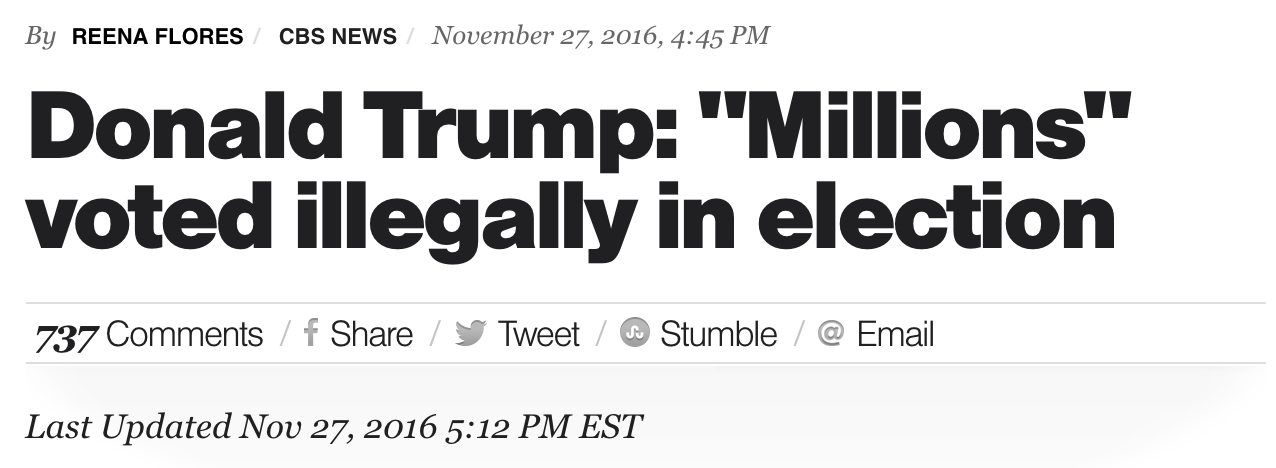
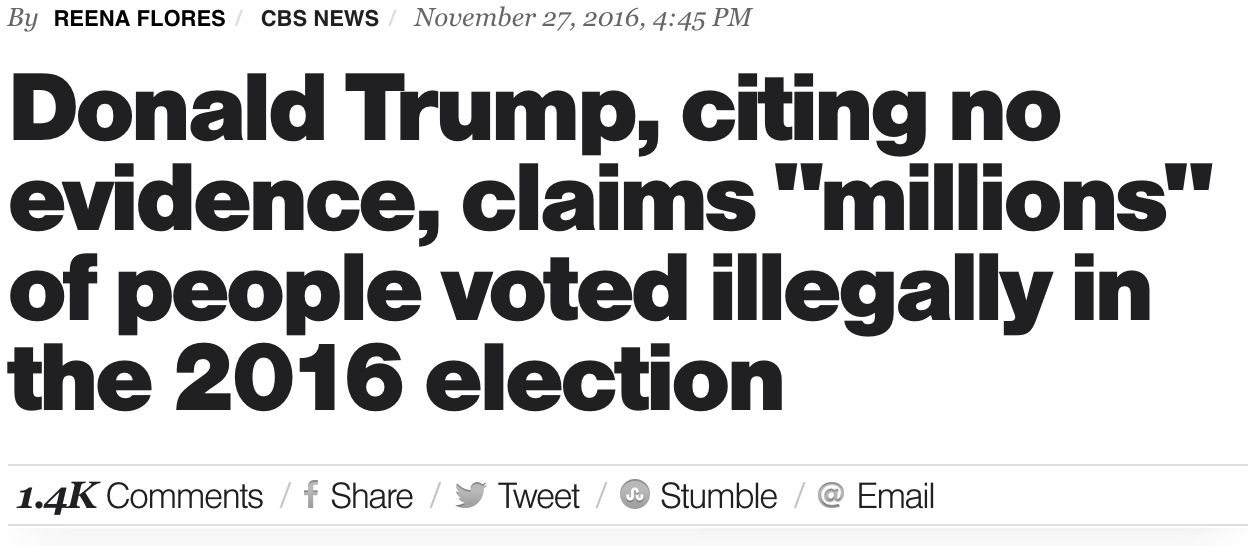
CBS had this headline up Nov. 27:

screen-shot-2016-11-27-at-8-33-09-pm

They caught hell for it online. For reasons I explain in this post: Evidence-based vs. accusation-driven reporting.

Around 8 pm that night, CBS changed the headline:

screen-shot-2016-11-27-at-8-33-36-pm

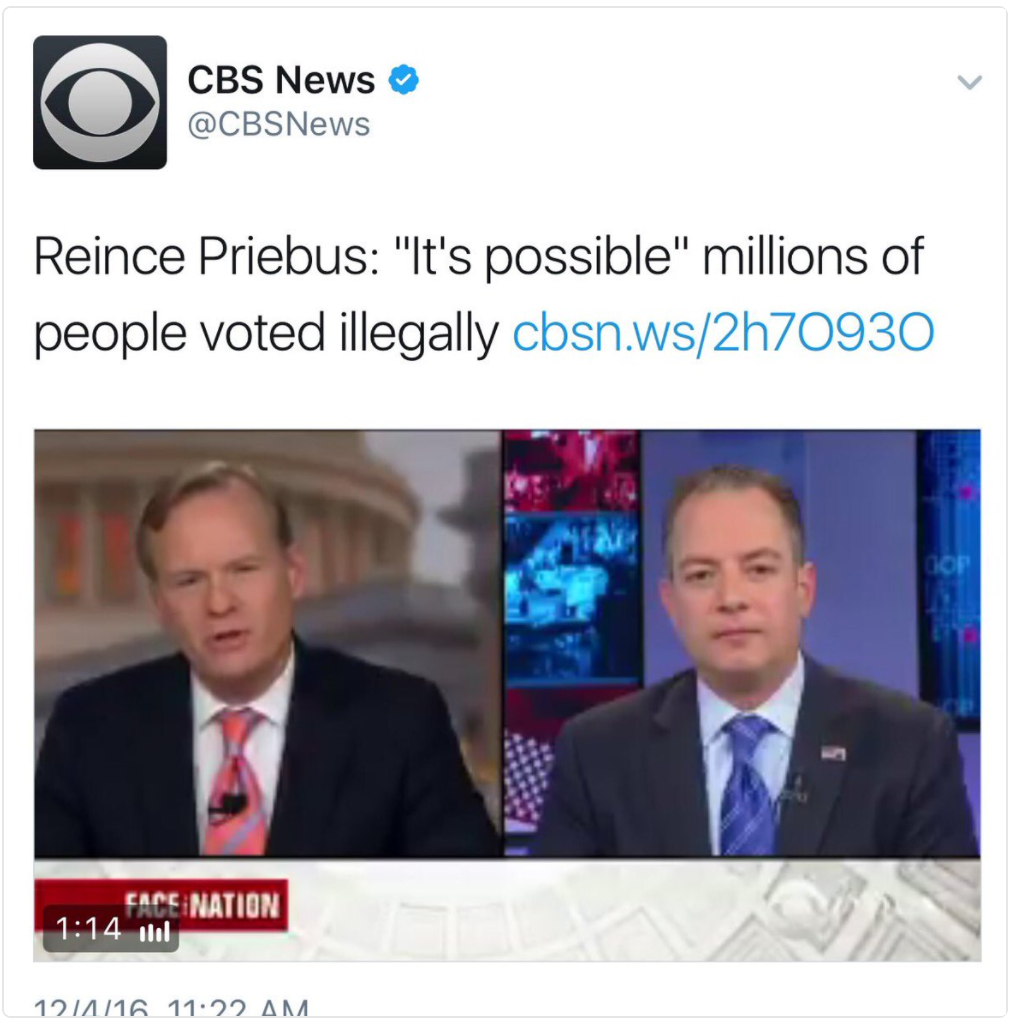
A week later, same deal: same mistake, same dispute: voter fraud. The original tweet:

screen-shot-2016-12-04-at-12-55-43-pm

Again they catch hell for it online. Again, they change it.

screen-shot-2016-12-04-at-12-56-21-pm

CBS News: You need a learning curve that’s steeper than this. You also need to graduate from “without evidence” to “just plain false.”

The Gamergate model of press relations

I remember the first time I heard about Gamergate. A random follower on Twitter asked me if I had been following the story.

22 Nov 2016 6:18 pm Comments Off on The Gamergate model of press relations

The Gamergate model of press relations

I remember the first time I heard about Gamergate. A random follower on Twitter asked me if I had been following the story, which he said was “about ethics in games journalism.” No, I had not been following the story. In all innocence, I clicked on the link he sent me and tried to make sense of what I read. I failed. The events it described were impenetrable to me. (Disclosure: I am not a gamer.)

Eventually I learned what Gamergate really was. The more I learned, the more depressed I felt. The people who promoted Gamergate said they were concerned about journalism ethics. As a professor of journalism with a social media bent, I felt obligated to examine their claims. When I did I discovered nasty troll behavior with a hard edge of misogyny. “It’s about ethics in games journalism” became an internet joke. Deservedly so.

Recently Ben Smith, the editor-in-chief of Buzzfeed’s news operation, wrote: “The big story of 2014 was Gamergate, the misogynistic movement championed by Breitbart and covered primarily by new media. That turned out to be a better predictor of the presidential election than any rubber chicken dinner in Iowa (or poll by a once-reputable pollster).”

Ben is right. The Gamergate model in press relations posits that high-risk tactics should not be ruled out of consideration. It says that rejection and ridicule by the mainstream media can be a massive plus, because events like these activate — and motivate  — your most committed supporters: your trolls. The Gamergate model proposes that transgressing the norms of American democracy is not some crippling defect, as previously believed, but a distinct advantage because the excitement around the transgression recruits new players to the fight, and guarantees the spread of your content.

The Gamergate model anticipates that the mainstream press will freak out. Full stop. And it seeks to profit from this reaction. What the traditional press considers negative publicity is, from the Gamergate point of view, a kind of gift to The Leader. Trump and his advisors have absorbed these lessons. Gamergate is thus one possible template for the future of White House-press corps relations. Those who have not studied it carefully will be at a distinct disadvantage.

The most common replies I receive on Twitter

Note: This list does not include abusive replies

18 Nov 2016 5:04 pm Comments Off on The most common replies I receive on Twitter

The most common replies I receive on Twitter

1. “And this surprises you?” Number one by a mile. Alt version: “I’m shocked, shocked to hear that…”

2. “But his supporters won’t care!” A reference to our president-elect. This one has been soaring lately.

3. “Nothing new here.” No claim of newness needs to have been made. The history lesson is going to come anyway.

4. “It’s about the ratings.” Because nothing else counts. Includes all versions of the “follow the money” cliche.

5. “It’s been tried, didn’t work.” A special version of “nothing new.” Favorite of the tech community.

Note: This list does not include abusive replies.

Reading list

In an effort to get some bearings, I am going back to some of the books that made me.

12 Nov 2016 12:30 pm Comments Off on Reading list

Reading list

fullerton_harbor_looking_south_chicago_feb_2_2011_stormSince the election unmade me as a writer, which is to say that I am still in pieces, I am this weekend going back to some of my intellectual sources. In an effort to get some bearings, I am going back to some of the books that made me. On the reading — sorry, re-reading — list:

Hannah Arendt, Crises of the Republic. (1972)
Hannah Arendt, Between Past and Future (1954)
C. Wright Mills, The Sociological Imagination (1959) I have a specific reason for this one. A key distinction he drew between “troubles” and “issues.”
Neil Postman, Amusing Ourselves to Death (1985)

And on the author’s advice I will be re-reading Chapter 3 of Ron Rosenbaum’s great book, Explaining Hitler. Here is what he told me:

“It’s all about the Munich Post in Munich who were investigating and harassing and exposing Hitler and his scandals from the moment he became local fuhrer until the dangerous months after he took power and finally shut them down. I take in other independent journalists of the time, but the Post was the only paper that dedicated itself to exposing enabling lies like ‘the stab in the back,’ obscure blackmail plots, and the daily toll of murders that did more than any elections to bring Hitler to power. Hitler called them ‘the Poison Kitchen’ because (in his mind) they never ceased ‘cooking up slanders against him.'”

Sounds perfect.

Winter is coming. It’s getting darker earlier.