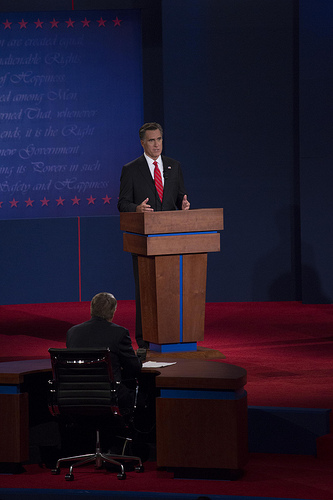
The vanishing moderator: Jim Lehrer answers your questions about his part in the first debate

"I was not there to question people. I was there to allow the candidates to question each other." Yeah, we saw that, Jim. Will Martha Raddatz of ABC News take the same approach in tonight's Vice Presidential debate?

11 Oct 2012 6:30 am 36 Comments

Warning! This is a synthetic product. All the answers are Jim Lehrer’s words quoted verbatim. Click on the red A. for the source and to check up on my scissoring. I crafted the questions myself as a way of stitching different interviews together, especially his appearance on WNYC radio and his interview with Politico. My purpose is to show how Jim Lehrer handles the doubts I have heard about his performance since last Wednesday. I did not interview Lehrer myself.

Q. It seemed to us, and a lot of other people, that you kind of lost control of the debate. Did you?

A. “It’s not my job to control the conversation. If the candidates gave me resistance, and I let them talk, to me that’s being an active moderator, not a passive moderator.”

Q. So letting them talk was what you were trying to do?

A. “I thought the format accomplished its purpose, which was to facilitate direct, extended exchanges between the candidates about issues of substance. Part of my moderator mission was to stay out of the way of the flow and I had no problems with doing so.”

Q. How did this format come about?

A. “The Commission came to me with this idea… Let’s see if we can try to have a real debate–not a moderated, simultaneous one-on-one interviews with the candidates, which is what they’ve been for all practical purposes–and set up a situation where the challenging is done not by the moderator, but is done by the candidates. And the candidates are either up to it or they’re not up to it. They’re either ready to go or not ready to go.”

Q. And if they’re reluctant to engage on the harder issues, which has been known to happen in politics, it would not be your job to prod or challenge them?

A. “I was not there to do the challenging. I was there to facilitate the challenging. If they didn’t want to do it, then I wasn’t going to do that work for them.”

Q. Okay, but does this extend even to keeping time? At several points in the debate, both candidates just rolled right over when you tried to enforce time limits. Was that part of the plan too?

A. “The first few times I said ‘let’s move on’ and they wanted to keep talking, the inclination of course is to stop them so I could cover all the subjects I wanted to cover. But I’m sitting there thinking, ‘Wait a minute, they’re talking to each other, leave ’em alone.’ So I backed off.”

Q. And are you happy with how it turned out?

A. “Sitting here talking to you now, I have absolutely no second thoughts about it. I think it was a major development in the growth of presidential debates.”

Q. Major development: How so?

A. “This is the first time in the history of American political campaigning where an incumbent president of the United States stood eyeball to eyeball to a challenger and they talked at each other and they talked about things that mattered. That each was allowed to challenge the other and respond to that challenge.”

Q. If it’s candidate to candidate, eyeball to eyeball, then why have a moderator at all?

A. “I don’t know if I’d go that far. But I think we took a step in that direction on Wednesday night and I think that’s a very good thing. It’s not about a moderator following up and asking tough questions. You can do that in interviews.”

Q. Mitt’s Romney’s comments on the 47 percent of Americans who see themselves as victims and want the government to take care of them: do you think that should have been part of a debate on domestic policy? You could have asked about it, but you didn’t. Why?

A. “The reason I didn’t ask that is because I felt those were the questions the two candidates were to ask. I was not there to question people. I was there to allow the candidates to question each other. Certainly I could have brought up the 47 percent. All kinds of things I could have brought up.”

Q. Were you bothered at all by the way Governor Romney at times bullied and interrupted you?

A. “Everybody saw it. If somebody was turned off by the way Romney interrupted me, then they saw it… Judge it and react accordingly.”

Q. What about a situation where a candidate lies or distorts the record, and his opponent is reluctant to go after him for his own reasons? The American people in that situation won’t even get a shot at the truth. That’s a problem, isn’t it?

A. “No, I couldn’t disagree with you more. This is ninety minutes in a campaign that’s already been underway for a year… This was ninety minutes of the two candidates showing who they are and what they were willing– if Obama made a decision, he didn’t want to do that, alright, now we know that.”

Q. So you’re not moved by any of the criticism since the debate?

A. I’ve heard some of the criticism, but it’s not keeeping me awake at night. My conscience is clear.”

* * *
Five comments of my own about Jim Lehrer’s responses:

1. They have integrity, in the sense that they form a coherent vision to which he held: Raise some big topics and get out of the way. Leave the follow-ups and the fact-checking to the candidates themselves. Don’t challenge them; instead, invite them to challenge each other. Lehrer unquestionably believes in this approach. He thinks it’s the right way to go for all the debates.

Dylan Byers of Politico reports: “Though criticism remains, many are beginning to warm to the idea — advocated by Lehrer and by the Commission on Presidential Debates — that the PBS Newshour veteran was actually setting a new standard for debate moderation by making himself all but invisible.”

2. It was not clear to anyone before the debate that we should expect the vanishing moderator, whose responsibility is reduced to a minimum. If Lehrer’s account is correct, the Commission kind of sprung it on us without warning. Byers, for example, wrote this in an extensively reported preview of the debate:

But at a time when the electorate is as divided as ever, and when media scrutiny is more intense than ever, his is a task that carries unprecedented responsibility. Lehrer, colleagues and campaign strategists say, must ask tough, substantive questions and yet maintain total impartiality. He must shepherd the candidates through a range of topics while allowing them to drive the debate. And he must push Obama and Romney for genuine responses without injecting himself into the conversation.

There was talk of the new format, including the eleven minutes of open conversation in each segment, but “Lehrer will actually play a more active role than ever,” Byers reported. Bill Wheatley, a former NBC executive vice president who has produced presidential debates, had this exchange with Nieman Lab, published October 1.

LaFrance: But, theoretically, with the continuity of one moderator and the opportunity for longer back-and-forths, the moderators are better positioned to challenge candidates in real time, call them out on misleading spin.

Wheatley: You would think so. And of course there’s lots of spin. It’s up to the moderator to decide when to interrupt — when to say, “That doesn’t square with the facts,” or something like that if a candidate goes that far. They’re generally pretty careful in the presidential debate not to make errors of fact, but they can.

Neither had any clue that the Commission had agreed to the vanishing moderator and that “calling them out on misleading spin” had been written out of the job description.

Here’s the executive director of the debate commission, Janet Brown, explaining the new format to the Washington Post: “Each debate will cover six topics lasting 15 minutes, picked by the moderator and announced ahead of time. That places a big burden on the moderator to use the time wisely to craft a good exchange. You can lob up names of accomplished journalists ‘til the cows come home, but it’s very hard to find someone who can do that.”

See what I mean? Nothing about: “I was not there to question people. I was there to allow the candidates to question each other.”

3. None of this lessens in any way President Obama’s responsibility for a listless and passive performance. In fact, it makes Obama’s failure look even larger. If Lehrer’s account is correct, then Obama and his team knew he could not count on Jim Lehrer to correct anything or raise uncomfortable issues. “The challenging is done not by the moderator,” as Lehrer put it. Romney got that memo. Obama did not.

4. Let’s see if Martha Raddatz of ABC News takes the same approach in tonight’s VP debate. Based on this Politico profile, it does not seem in character for her, but who knows? If she does toss them a topic and get out of the way, it will validate Jim Lehrer’s explanation: the Commission’s plan all along was to install the vanishing moderator. (“I was not there to question people…”) If she does not take his approach, the story gets more interesting because then the opacity of the Debate Commission becomes even more outrageous.

5. For me it’s impossible to overlook the congruence or fit between these two things: 1.) Lehrer’s vanishing moderator who does not challenge or correct but merely “facilitates” the exchange between party leaders and 2.) the weakness of the PBS system itself, especially the Newshour, it’s flagship program best known for those non-confrontational interviews that allow the talking points on both sides to pour forth. The problem for PBS is not the imperative to remain impartial. It’s the assumption that impartiality is well served by the genteel style. There are more muscular forms of impartial journalism but you rarely see them in action on the Newshour, which is still dominated by Lehrer’s presence even though he is mostly retired.

I note, as well, that the imperative at PBS to avoid criticism (even when they know that the culture war attacks are coming) is congruent with Lehrer’s approach. He knew he would get a lot of criticism after the debate. But since he defined his primary job as “get out of the way,” the only valid criticism–by his lights–is that he did not get out of the way fast enough. As far as I know, no one has made that point about Jim Lehrer.

Post-script: October 12, the morning after the Vice Presidential debate.
Jim Lehrer has said that the new format put in place by the Commission on Presidential Debates included what I have called the Vanishing Moderator. As he put it, “I was not there to question people. I was there to allow the candidates to question each other.” He presented this approach as part of the Commission’s plan to advance the art of presidential debates, a decision he agreed with and embraced.

But now those explanations look kind of strange because it would appear that Martha Raddatz of ABC News undid the shift to the Vanishing Moderator in last night’s Vice Presidential debate. As Alessandra Stanley of the New York Times wrote:

Mr. Biden was not the only one in the room intent on rectifying his predecessor’s mistakes. Martha Raddatz of ABC News was the moderator, and she made a point of speaking forcefully, pushing the candidates to be specific and changing subjects abruptly. She seemed determined to be less passive and sleepy than Jim Lehrer of PBS was as moderator of the Obama-Romney debate.

Andrew Rosenthal of the Times opinion staff noted:

Ms. Raddatz showed a consistent willingness to call the candidates on their “malarkey,” as the Vice President put it. When Mr. Ryan said he could cut taxes without reducing the deficit by eliminating loopholes, but didn’t actually mention which loopholes, she drew attention to his evasiveness: “No specifics, again.”

And she refused to let Mr. Ryan ignore her question about his ticket’s plan to increase the defense budget. By my count, she returned to that point six times, culminating with the rather sharp: “I want to know how you do the math and have this increase in defense spending?”

With 15 minutes left, after dragging the candidates through taxes, Medicare, Social Security, the budget deficit, terrorism and Afghanistan, she raised a topic that didn’t come up at all last week: How did each of the candidates’ personal beliefs (they are both Catholic) affect their views on abortion.

This is the very opposite of the policy that Lehrer said the Commission had decided on, with his enthusiastic support. In the Vanishing Moderator scheme, interventions like refusing to let Paul Ryan ignore questions about the defense budget would be left up to the candidates. It would be Biden’s job. That Raddatz saw it as her job represented a shift in policy from the week before. Which leaves us with these questions: Did Martha Raddatz go off the reservation and simply ignore the Commission’s new Vanishing Moderator format? Was it never the Commission’s intention to make the Vanishing Moderator part of its debate scheme? (Lehrer said it was.) Did the Commission change its mind without telling anyone? Was Lehrer’s story (scroll up for the quotes) incorrect in some way? We don’t know.

UPDATE, Three months after the election: Lehrer, Raddatz disagree on debate role.


The clash of absolutes and the on-air fact check

Soledad O’Brien makes political television slightly realer-er when she comes ready to fight on air for a documented fact. Yes, I have a clip to show you.

18 Sep 2012 12:35 pm 33 Comments

The fact checkers in the press have spoken on a key Republican Party claim: that President Obama has gone around the world “apologizing for America.” Here are the speeches in question. And here are the checks:

Politifact.com: Obama’s remarks never a true ‘apology’. The claim is rated false.

Washington Post fact checker: Obama’s ‘Apology Tour.’ Four Pinocchios, which means a whopping lie.

Factcheck.org: Romney’s Sorry ‘Apology’ Dig. “We’ve read through the speeches as well. We’ve come to the same conclusion: Nowhere did we see that the president ‘apologized’ for America.”

Yesterday, Republican Congressman Peter King was on CNN with Soledad O’Brien. He mentioned “the apology tour.” O’Brien, well aware of the fact checkers’ verdict, decided to challenge him. First you watch, then we talk:

(more…)

#presspushback

"Professional journalists, whose self-image starts with: 'We're a check on...' had to decide what to do about the truck that just ran their checkpoint, carrying the brain trust of the Romney campaign, laughing at how easy it all was."

31 Aug 2012 4:05 pm 50 Comments

This week, one of the presidential campaigns said: “We defy the fact checkers. Your move, journalists.” The political press reacted with some signs of a push back. These are my notes and key links from that event, Aug. 26 to 31, the week of the Republican convention.

1. “You’re entitled to your own opinion. You’re not entitled to your own facts.” On Sunday I posted at PressThink about the coming conflict between the fact-checking press and the forces in politics who seem ready to override it:

Suppose there arose on the political scene a practical caucus for the opposite view. We are entitled to our own facts, and we will show you what we think of your attempt to “check” us. If that happened, would the press know what to do?

This week, it kind of happened.

2. “You have a news alert.” On Aug. 28 Buzzfeed’s Ben Smith reported from a breakfast briefing at the Republican convention in Tampa the clarifying remarks of Mitt Romney’s pollster, Neil Newhouse: “We’re not going to let our campaign be dictated by fact checkers.”

Exactly! They’re not. Which is like saying to political journalists: your move, fellas. Smith’s fuller report:

The welfare ad has been the center of intense dispute, with Democrats accusing Romney of unearthing old racial ghosts and Romney pointing out that the Obama Administration has offered states waivers that could, in fact, lighten work requirements in welfare, a central issue in Bill Clinton’s 1996 revamping of public assistance.

The Washington Post’s “Fact Checker” awarded Romney’s ad “four Pinocchios,” a measure Romney pollster Neil Newhouse dismissed.

(more…)

“You’re not entitled to your own facts” vs. That’s your opinion. Kiss my ad.

So what do we do about that divide? And what if the problem isn't evenly distributed across the landscape or within a party, but pools and concentrates in certain spots? Do journalists go to those (malignant) spots and fight?

24 Aug 2012 8:45 am 93 Comments

The lines are usually attributed to Daniel Patrick Moynihan: “You’re entitled to your own opinions. You’re not entitled to your own facts.”

But suppose there arose on the political scene a practical caucus for the opposite view. We are entitled to our own facts, and we will show you what we think of your attempt to “check” us. If that happened, would the press know what to do?

We hear quite a bit about the partisan divide in Washington and around the country. We hear a lot less about the divide around Moynihan’s famous lines. Those who think you’re not entitled to your own facts vs. those who dispute the statement. Or feel unbound from it. Or they simply run right over it trying to win today’s battle or deliver today’s news.

“Hey, you’re not entitled to your own facts…” vs: That’s your opinion. Kiss my ad. Read my poll.

Evidence that others at least know what I’m talking about came from David S. Bernstein of the Boston Phoenix (an occasional critic of mine) who recently sent this plea out over Twitter:

Dear media critics: OK, entire news media called Romney’s welfare attack a lie. Campaign still pushing it. Now what?

I don’t know the answer. I do know that it’s troubling to other journalists sifting through the 2012 campaign. Two weeks ago a bureau chief wrote to me for comment on a story he was doing about the same development. My reply:

If we start back in the 1990s and read forward to the current campaign, we see distinct phases of innovation as political journalists react to misleading ads: first, the ad watch phase in the 90s; there was some mention of misleading elements, but the final tally was about effectiveness, or what I call “savvy.” The limitations of the ad watch led to direct fact-checking by the press, where actual grades are handed out. The emphasis is on judging truth and falsehood, not assessing effectiveness. So now we’re in a new phase: fact checking alone is not enough. The campaigns seem able to override it, which does not mean they override it equally or with the same vengeance. So what’s the next innovation?

He wrote back: right, well what is the next innovation? Again: I don’t know. (Hit the comment button if you do know.)

(more…)

Everything That’s Wrong with Political Journalism in One Washington Post Item

So what is the job of a political journalist today? Is it to describe the reality of American politics, as a "straight" reporter would? Or is it to defend reality and its "base" in American politics... more like a fact checker would?

5 Aug 2012 2:19 am 57 Comments

I was alerted to the find by Alec MacGillis of the New Republic. He was exasperated by this brief report in the Washington Post, which appeared at The Fix, the Post’s top political blog. If you don’t know it, The Fix is a reporting and analysis franchise built around the many talents of Chris Cillizza, a star reporter and key presence on its most important beat: national politics.

The Fix is a group blog now; the item in question carried the byline of political reporter Aaron Blake. It’s a 700-word analysis of a Mitt Romney ad that twisted some words of Obama’s into a claim that could be more easily attacked:

Context be damned: Obama’s ‘It worked’ quote should work for Republicans.

Context is dead. Long live context.

For the second time in two weeks, Mitt Romney’s campaign has an out-of-context quote it can use to bludgeon President Obama. First it was “You didn’t build that,” and now it’s two ill-fated words that Obama spoke at a fundraiser Monday: “It worked.”

As with “You didn’t build that,” the Romney campaign’s attacks on “It worked” will be criticized for being out-of-context, lowest-common-denominator politics. And as with “You didn’t build that,” “It worked” is going to … well … work.

The rest of the item runs in this vein: Scream all you want about “context” and accuracy; these ads are effective, and that’s what counts. Listen to a bit more:

Fact-checkers are great (especially our Glenn Kessler), but as long as either side has an argument to justify its attacks, the history of politics dictates that it’s all fair game.

Romney’s team is exploiting that fact — to the credit of its political acumen, if not its strict adherence to accuracy.

Some people don’t hear it, others do: the way the tone of the piece… don’t get me wrong, fact checkers are great, but… eats away at our confidence that this kind of journalism can ever be the truthelling kind. MacGillis of the New Republic heard it. “Ah yes,” he wrote. “If only there was someone whose job and calling it was to ferret out the truth of such things, to provide some context for voters. Let me think, there must be someone we can think of, a profession of some kind perhaps, sort of like a researcher but also a communicator…”

(more…)

The Boston Globe reports: Mitt Romney stayed at Bain 3 years longer than he stated. ”Firm’s 2002 filings identify him as CEO, though he said he left in 1999.”

Fallout. Which fits well into the controversy of the day template, that reusable campaign good.

Un-templated: Suppose a major party candidate for president believed we were in a “post-truth” era and actually campaigned that way. Would political reporters in the mainstream press figure it out and tell us?

I say no. They would not tell us. Not in any clear way.

Instead, they would do what the Globe did here: try to nail the candidate on specific misstatements that can be documented. Which is good and necessary and difficult and contentious and honorable. Keep going, Boston Globe! And don’t forget to credit others who have done similar work.

What template is there for reporting on a strategy that incorporates…

1.) Key lesson of the climate change debate: you can run a political campaign against verifiable facts, and thereby weaken those facts in the public’s mind.

2.) The Palin-ator: you can invent stuff and stick with it when it is shown to be false because culture war politics feeds off the noise and friction when fictional claims are fact-checked by the mainstream media.

3.) David Frum’s observation from within the Republican tent: “Backed by their own wing of the book-publishing industry and supported by think tanks that increasingly function as public-relations agencies, conservatives have built a whole alternative knowledge system, with its own facts, its own history, its own laws of economics.”

4.) Old-fashioned secrecy, as in: don’t release information, don’t explain.

(more…)