The Citizens Agenda: A Plan to Make Election Coverage More Useful to People

I'm teaming up with The Guardian to try something different in campaign journalism. Here's the announcement post, with my commentary after it.

8 Dec 2011 8:05 am 16 Comments

The Citizens Agenda: Making Election Coverage More Useful
Co-published with The Guardian.

by Amanda Michel and Jay Rosen

In a few weeks, the Iowa caucuses will officially kick off the 2012 campaign for president and we’ll begin to get answers to the questions that obsess our political press: who’s gonna win? What is the winning strategy?

We’re equally obsessed with a different question: how can Americans get a “win” in the election of 2012? Meaning: the kind of dialogue they deserve, a campaign that connects to their deepest concerns and helps them make sense of the cascading problems now before the United States. And if you share our obsession, you can help us get started or follow along.

Presidential elections are a race – a marathon, as the exhausted candidate often says. They are national spectacles, not around the edges but at their core. Elections are comedies, too, a rolling entertainment. And so there has to be a place for horse race polls, game day coverage, personality journalism, political carnival, and even for front-page stories on the guy who cuts the candidate’s hair.

But we think it will be a loss for the public, and the press, if no revision is made in the master narrative for election coverage, which treats politics as a strategic game in order to ask – endlessly – what it’s going to take to win in 2012. That engine is by now exhausted. It cannot do the work we need the press to do if Americans are going to get the kind of debate they deserve. But what are the alternatives?

In 2008, the two of us teamed up with the Huffington Post to try to improve election coverage by broadening participation in it. We called that project OffTheBus. It relied on the public, people who were not political journalists, and thus not inside the campaign bubble. Who’s gonna win? was not their typical starting point. More like: where and how does this campaign touch my life? They covered those connecting points from small towns to big cities, offered a look inside their local campaign HQs, analyzed campaign expenditure data, sifted through campaign material for trends and anomalies, and profiled almost all of the so-called “super delegates,” who had a big role in the nomination battle that Barack Obama won. Just as Obama’s campaign empowered the grassroots, OffTheBus “let the roots guide its coverage.”

OffTheBus brought networking methods to campaign reporting and commentary. We eventually enlisted 12,000 people, partly on the strength of a simple idea: democracy is about participating, so let’s extend that principle to the campaign news system and see if we can make it work. We learned that there’s great potential in this kind journalism – imagine the expertise and observational powers of 12,000 pairs of eyes and ears – but also a long way to go. Fortunately, the Hufffington Post is going to continue with OffTheBus in 2012. We look forward to seeing what they do with it.

Meanwhile, we have another idea. We want to go right at the problem of an exhausted master narrative. It’s time to attempt a replacement – or replacements. So that is what Guardian US and NYU’s Studio 20 program in journalism are going to do in 2012, using some of what we learned from OffTheBus and also from The Guardian’s own experiments in pro-am and crowdsourced journalism. The alternative to who’s going to win in the game of getting elected? is, we think, a “citizens agenda” approach to campaign coverage. It starts with a question: what do voters want the candidates to be discussing as they compete with each other in 2012? If we can get enough people to answer to that question, we’ll have an alternative to election coverage as usual.

The Guardian’s over-arching commitment to an open and collaborative newsroom makes it a natural home for the citizens agenda. It recently unveiled guardiannews.com, announced its plans to report for a US audience, and has begun staffing up (We’re looking for a social media editor and a community coordinator). Here’s how Janine Gibson, editor-in-chief of Guardian US, puts it:

Although The Guardian has had talented correspondents in the US for some time now and has covered many elections here, they have always been foreign correspondents, reporting back for a UK audience. Now we’ve launched in the US and are publishing to US readers, we wanted to make sure our coverage was distinctive and added something to the general noise and swirl of an election campaign. Our starting position was, ‘We’re new in town. How could we possibly pretend to know what the US electorate wants to hear from its prospective representatives?’ Best, in that circumstance, to ask the question, we thought.

The citizens agenda is a simple concept, and our approach is fairly straightforward: we aim to identify and articulate the citizens agenda, and to help set up The Guardian for its general election coverage by experimenting with citizens agenda features and approaches. Studio 20 students will work alongside The Guardian’s journalists in brainstorming, designing and managing features on guardiannews.com through early May 2012. Together we will arrive at the picture of how people want journalists to cover the election through a number of traditional and non-traditional methods, including sampling science, internet polling, web forms, social media, old fashioned reporting, discussions and debates, experimental features, plus staff and user-generated content. Starting in late January, when students are back in session and the primaries are presumably winding down, we will launch our first features. Between February and May we will iterate and edit our approach.

Working parallel to The Guardian’s project will be local newsrooms doing essentially the same thing, but for statewide and local elections. The Media News and Journal Register companies, under the joint management of Digital First Media, plan to develop the citizens agenda approach in their own election coverage, collaborating with The Guardian on the best ways to discern what voters want the campaign to be about.

We hope that other local news organizations will want to join in as the experiment takes shape. The more that do, the better our chances for learning how to do it right.

“For any local news organization to be successful down the road, it needs to engage its citizens in meaningful ways, and to me, this is a perfect example of how we can and should do that,” said Jim Brady, editor-in-chief of Digital First Media.

I think the partnership with The Guardian is a model for national-local media partnerships that I hope will continue to evolve. The Guardian will take on the huge national piece of the citizens agenda, and at Journal Register Company and MediaNews Group papers, we’ll localize it. So, in every city or town where we have a news organization, we’ll be able to find out what citizens are most interested in discussing and try and get them the answers they need to make an informed decision when they show up to vote.

The initial goal of this kind of journalism is to expose the demand for news and views around problems the voters see as real and urgent. In other words: What do you want the candidates to be discussing as they compete for votes in 2012?

Or: what should this campaign be about? Social media and the two-way nature of the Internet make it possible to ask that question of many more people than you could reach in a poll, although polling is important for reliability.

The answers that come in form the basis for the citizens agenda. It won’t be a single issue, of course, but a basket of top concerns broadly shared by respondents – six to ten, or perhaps as many as a dozen priorities that originate not with journalists or campaign managers, but with voters. Some may be different from the issues the operatives see as advantageous to their candidate, or maybe not. The point is that we won’t know until we ask.

Once synthesized, the citizens agenda can be used as an alternative starting point for The Guardian’s campaign journalism. When the candidates speak, their promises and agendas are mapped against the citizens agenda. Reporters assigned to cover the campaign can dig deep on the items that make up the citizen’s agenda. In questioning the candidates, The Guardian will ask about things that flow from that agenda. Explainers should try to clarify and demystify the problems named in the citizens agenda.

What the voters want the candidates to be discussing is not a static thing, nor is it easy to determine. So we will have to keep working at it until we get it right, which is part of the reason The Guardian is collaborating with a journalism school. This is an experiment. Last spring, Studio 20 worked with ProPublica.org on how to create better explainers. That project will feed into this one.

The ultimate goal of a citizens agenda is to bring the candidates to it, so that what people want the candidates to be discussing is actually addressed. Campaign coverage gains a clear purpose: information and access that is useful to people in getting their priorities addressed.

That’s a goal worth obsessing about. So, now it’s your turn: how do you recommend we get started? Where do we look for inspiration? And what do you see as the campaign’s core issues? Please join us in the comments below or add #citizensagenda to your tweets.

* * *

Additional notes and commentary by Jay Rosen

1. Amanda Michel is the Open Editor of The Guardian US. She started there in November. We worked together on Assignment Zero, OffTheBus, Building a Better Explainer and now The Citizens Agenda. All of them are attempts to include the users more effectively in the practice of journalism.

2. We’re hoping to interest other news organizations in taking this approach to the 2012 elections. Whenever you try something different like this, there are lots of problems. The more sites the experiment runs at, the more likely we are to solve those problems. If you’re an editor or news executive and want to try the citizens agenda approach, email me or leave a comment here.

3. This project comes directly out of an earlier post of mine: The Citizens Agenda in Campaign Coverage. That post was in turn inspired by a 1992 project at The Charlotte Observer, by a 1990 project at the Wichita Eagle, and by the words of David Broder, the most revered political reporter of his generation, who said in a 1991 speech:

…If we are going to change the pattern, we in the press have to try deliberately to reposition ourselves in the process. We have to try to distance ourselves from the people we write about–the politicians and their political consultants–and move ourselves closer to the people that we write for– the voters and potential voters.

That’s what we’re doing. It’s not revolutionary. It’s what Broder thought necessary twenty years ago. The campaign should be treated as the property of the voters, he said, for they “have a right to have their concerns addressed and their questions answered by the people who are seeking to exercise power.” Yeah. Exactly.

4. What I like about this project is that the whole thing pivots around a single question: What do you want the candidates to be discussing as they compete for votes in 2012? That’s easy to state, and only 16 words. But it’s going to be hard to do. I think we’re going to need all methods known to woman and man: random sampling to provide statistical validity, old-fashioned reporting, blogging and citizen journalism, web forms we ask people to fill out, the polling of networks, social media of course including the Twitter hashtag #citizensagenda, SMS, voice mail even, and several methods we have not devised yet. Got ideas? Hit the comment button.

The citizens agenda, as we’re picturing it, will be an editorial product, made by The Guardian newsroom from the answers received to our “master” question. It will require interpretation. It will involve an editor’s judgment. But mostly, it will be a creative act of listening.

5. I am on the advisory board of Digital First Media, which will be bringing the same approach to local elections. (A feature on its CEO, John Paton.) “While coverage of the overall election — from the horse race to the conventions to the political theater — will remain part of our coverage, we agree with the idea that citizens should have a larger role in determining the issues that are discussed and covered,” said Jim Brady, Editor-in-Chief of Digital First Media. “Taking this community-driven approach to elections fits right into our overall philosophy of combining traditional journalism values with new, bold experiments.”

6. Alan Rusbridger, editor of The Guardian in London, in a speech last year.

Many of the Guardian’s most interesting experiments at the moment lie in this area of combining what we know, or believe, or think, or have found out, with the experience, range, opinions, expertise and passions of the people who read us, or visit us or want to participate rather than passively receive… It is not about replacing the skills and knowledge of journalists with (that ugly phrase) user generated content. It is about experimenting with the balance of what we know, what we can do, with what they know, what they can do… There is a mutualised interest here. We are reaching towards the idea of a mutualised news organisation.

This project participates in that.

After Matter: Notes, Reactions & Links…

NiemanLab covers the announcement: Civic journalism 2.0: The Guardian and NYU launch a “citizens agenda” for 2012.

Once you know what people want from political journalism, how do you go about creating that journalism? What’s the right balance between competition-based, and issue-based, coverage? What’s the right balance, for that matter, between journalists determining coverage and the public determining it?

“We applaud your goal and will be interested in how you assess the citizens’ agenda. Our newspaper in Florida is attempting something similar…” That’s the spirit.

Me, on Twitter:

#citizensagenda: What do you want the candidates to be discussing as they compete for votes in 2012? OK, I’ll go first. jr.ly/7ndb

You can play too. The format is..
1. the #citizensagenda hashtag
2. what you want the candidates to be discussing
3. a link that can inform us about 2.)

Isn’t this just focus group research, like the campaigns conduct in order to sell their candidates? Well, uh… no, not really.

The professionals call them “cycles.” Civilians call them elections. From the last cycle, 2008: Why Campaign Coverage Sucks.

I think a case can be made that improving campaign dialogue–the news, as well as the discourse–is not just a problem, but a wicked problem.

This is the way the horse race should be done. Then assign reporters and editors to a better master narrative.

Official press release from The Guardian on this project.
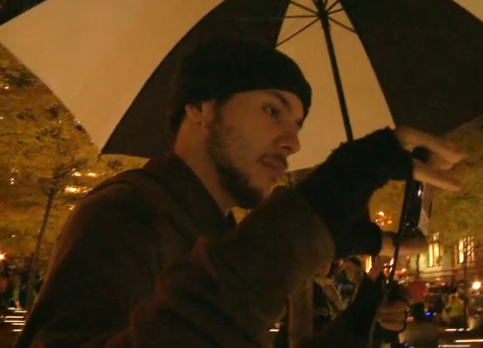
 

Occupy PressThink: Tim Pool

"Being a livestream he acts as 'eyes and ears' for the viewers. Literally. People will tell him to move the camera somewhere and he'll do it. They'll ask for interviews with someone, and Tim will go over and do so... The viewers will ask him questions and he won't rest until he gets them their answers."

20 Nov 2011 1:26 am 18 Comments

Recently, Alexis Madrigal, the technology editor of The Atlantic and pretty much the smartest young journalist ’round these parts, re-described occupy Wall Street as an API, or Application Programming Interface.

What he meant is that one of the distinctive features of the movement is its “open” design. “From the beginning, the occupation was meant to take on a life of its own. Organizers and occupiers alike have not tried to maintain control of the message or methodology for spreading ideas or occupations. Anyone who wants to support Occupy Wall Street can just do something, trusting they’ll be able to connect to the movement. Hence OccupyHistory and hundreds of like sites.”

How is Occupy Wall Street “like” an API? Madrigal explains:

API is an acronym for Application Programming Interface. APIs allow data to be pulled from an online source in a structured way. So, Twitter has an API that lets app developers create software that can display your Twitter feed in ways that the company itself did not develop. Developers make a call to that API to “GET statuses/home timeline” and Twitter sends back “the 20 most recent statuses” for a user.

What an API does, in essence, is make it easy for the information a service contains to be integrated with the wider Internet. So, to make the metaphor here clear, Occupy Wall Street today can be seen like the early days of Twitter.com. Nearly everyone accessed Twitter information through clients developed by people outside the Twitter HQ. These co-developers made Twitter vastly more useful by adding their own ideas to the basic functionality of the social network. These developers don’t have to take in all of OWS data or use all of the strategies developed at OWS. Instead, they can choose the most useful information streams for their own individual applications (i.e. occupations, memes, websites, essays, policy papers).

I think it’s a beautiful way of describing the movement. Madrigal’s section on social media:

GET Strategy/social media: Occupy Wall Street had a social media strategy from the beginning. They encouraged all protesters to record their experiences with cell phones and cameras and then used that media to drive awareness of the protest in its early days. Since then, a whole network of social media has emerged from Twitter accounts to Facebook pages to wikis. This web is woven together by a media team as well as outsiders who have begun to act as signal amplifiers and filters. A particularly effective outside effort was the WeArethe99Percent tumblr, which presented stories of everyday people who were struggling despite their hard work.

The social media API works in tandem with the Big Media “interface,” a portion of which is:

GET Decentralized leadership structure: Repeat mantra that the movement is ‘leaderless.’ In practice, have no single leader on whom the media and/or public can focus. Avoid profiles of organizers….

That’s all background to this letter I got. It’s a perfect example of… “Anyone who wants to support Occupy Wall Street can just do something.” The letter tells of an adventure in citizen journalism unfolding around Occupy Wall Street. Chris Fornof explains it as well as I could, so I am going to shut up and let you listen to him.

Nov. 18, 2011

Greetings!

This is Chris Fornof. You likely don’t remember me, but I was involved briefly with Assignment Zero. I’m a huge supporter of citizen journalism and try to help out in little ways where I can.

I’ve been glued to media coverage of #Occupy, and I saw something this week that I thought you’d be interested in.

Tim Pool.

Something very special is happening here.

Basically he’s a protester-turned-reporter with a cell phone who is doing some very uniquely awesome things with his streaming ustream coverage. He’s been doing 20-hour live reporting marathons, but what’s extremely powerful is the feedback loop that he has with his viewers (numbering in the 15k+ live, 100k+ daily).

There’s a unique symbiosis happening. Being a livestream he acts as “eyes and ears” for the viewers. Literally. People will tell him to move the camera somewhere and he’ll do it. They’ll ask for interviews with someone, and Tim will go over and do so (taking extensive feedback, questions, and commentary from the channel viewers). The viewers will ask him questions and he won’t rest until he gets them their answers. There is no delay or time to press. It’s instant. And it’s awesome.

But it goes both ways.

When his camera battery goes low, people swarm into action. Purchasing batteries, locating someone on the ground to deliver, and coordinating delivery. He’s got a dozen batteries, pack and chargers just donated to him so he can keep recording. He mentions he’s getting hungry and somehow people make sure he’s fed with a constant stream of random strangers exactly what he needs when he needs it. This also extends to a few thousand people that will devour twitter and live news feeds to give him active intel so he can stay safe.

The goodwill he’s engendering is ridiculous. Beyond the participation, there’s relationships happening here. I have never seen this kind of support for a journalist before. He logs off for the night and hundreds of people stream in their “THANK YOU!”s and undying gratitude.

He’s got some TIME people following him for the past few days. I expect you’ll hear more about him soon. (Link.) I strongly feel that the kind of reporting he’s doing represents the future of what citizen journalism could be.

There have been a few dozen livestreams of the protests that have been fascinating to watch, but Pool has been one of the first to engage viewers like this.

I was hoping sometime that you may be able to get in touch with him. Perhaps advise him. You are well connected in the field of journalism and can likely appreciate the uniqueness of what is happening here. From watching his interactions, Tim seems very level-headed and could likely serve as a good case-study for citizen journalism in action. Who knows?

Anyways.

Thank you for your tireless support for citizen journalism over the years. It’s a long-haul trip but I think the world is finally waking up to the things you’ve been saying. Keep up the great work!

-Chris

Occupy PressThink (see how well that API works?…) has a few comments about this.

1. Since I know how the term enrages people, I am going to quote my definition of citizen journalism:

When the people formerly known as the audience employ the press tools they have in their possession to inform one another, that’s citizen journalism.

Tim Pool is a perfect example. In fact, I can’t think of a better illustration of what I was trying to get across in sculpting that definition.

2. It’s hard to overlook the fact that his name is Pool. In pressland, a “pool” report is what happens when the entire press corps can’t have access to a news event, so a representative team of 3-4 reporters is sent and their accounts are then shared with the whole gang. They have to be the eyes and ears for others. They have to ask what others would ask. They can’t keep what they find out to themselves. In a way, that’s what Tim Pool does.

3. In his epic post, Newspapers and Thinking the Unthinkable, my colleague Clay Shirky writes: “If the old model is broken, what will work in its place? The answer is: Nothing will work, but everything might. Now is the time for experiments, lots and lots of experiments, each of which will seem as minor at launch as craigslist did, as Wikipedia did…”

Yes. And one of the things we need to experiment with is the relationship (sorry, can’t think of a better word) between journalists and the people who depend on them for reports. “When his camera battery goes low, people swarm into action…” is just that: an experiment in what this relationship could be like: We’ll help you, we’ll feed you, just keep the reports coming.

I wrote about an earlier example of this kind of relationship here: They’re Not in Your Club but They Are in Your League: Firedoglake at the Libby Trial (2007.) As Shirky says, we need more experiments in how the (dependent) users can support the (independent) reporters.

4. From Wikipedia: Pool broadcasts using his 4G Samsung Galaxy SII. See this report on Pool for more on his tech.

5. This might be a good time to mention that Tim Pool is clearly an activist and supporter of Occupy Wall Street as well as a reporter of it. If you believe those things can’t possibly go together, fine, I know where you’re coming from. But don’t expect me to freak out or even care that you wouldn’t call Pool a journalist. As I’ve said before, we should focus less on “who’s a journalist” and more on valid acts of journalism. When we can recognize the act, the “who” becomes easier: anyone committing the act!

6. When young people ask me what they should do if they want to become a journalist, here is what I normally tell them: the most important thing is not to go to J-school, or start a blog, or get a newspaper to hire you (though all those things are good!) but to get yourself into a “journalistic situation.” A journalistic situation is when a live community is depending on you for regular reports about some unfolding thing that clearly matters to them.

If you really want to be a journalist the best experience you can have is to be depended on by people who need you as their eyes and ears, their interviewer, their man or woman in the field. Tim Pool: he’s in a journalistic situation, classically so. And I bet he’s learning a lot from it.

After Matter: Notes, Reactions & Links…

See also my Tumblr post: Tim Pool, the man behind @TheOther99, is bringing the Max Headroom prophecy to life.

GigaOm: Occupy my TV: The birth of the citizen video reporter. Follows up on this post with a trend story.

Fast Company: Tim Pool And Henry Ferry: The Men Behind Occupy Wall Street’s Live Stream.

NPR’s On the Media: Q and A with Tim Pool.

Mathew Ingram: What happens when journalism is everywhere?

Photo by Paintballbudd. Commons Attribution-Share Alike 3.0 Unported license.)

You can follow Tim Pool on Twitter and get word on when he’s live streaming that way.

“Low information voters” and the political press

What if journalists sense that their work never reaches the voters whose inattentiveness is being exploited? What if they somehow know that voters are getting screwed but they've lost faith in their ability to do anything about it?

17 Nov 2011 3:32 pm 26 Comments

Last week, Ezra Klein, the Washington Post’s policy wonk who is rapidly becoming their most valuable journalist, brought to our attention a fascinating paper by six political scientists. It’s called A Theory of Parties. I am going to take a little time here to summarize what it says:

“Parties no longer compete to win elections by giving voters the policies voters want,” they write. “Rather, as coalitions of intense policy demanders, they have their own agendas and aim to get voters to go along.”

In the United States, at least, parties are not politicians of a similar mind banding together to win elections, but “coalitions of narrow interests in pursuit of policy demands” that aren’t necessarily in the interest of the broader public. They “only strive to please voters when necessary to win elections.” But this constraint often doesn’t amount to much “due to voters’ lack of information about politics.” The goal, sometimes conscious, sometimes not, is to “cede as little [influence] to voters as possible.” The need to win elections occasionally requires “genuine responsiveness,” but parties mainly push their own agendas and try to get voters to acquiesce.

Interest groups pushing policy demands at odds with the interests of most voters have an especially large advantage at the nomination stage of elections, the authors write. “Most citizens pay little enough attention to general elections and even less to nominations. The few who vote in primaries lack the anchoring cue of candidate partisanship, rendering them open to persuasion. Media coverage of primaries is also generally less than in general elections, further increasing the expected impact of small amounts of paid communication.”

Here is the part that intrigued me as the author of PressThink: “To explain the substantial autonomy we believe parties enjoy, we posit an ‘electoral blind spot’ within which voters do not monitor party behavior.” Through various institutional devices, like complex party rules and procedural votes that no one understands, the major parties “seek to exploit lapses in voter attentiveness” and “keep the electoral blind spot as large as possible.”

To be sure, parties must tread carefully. As V.O. Key famously argued, voters are not fools. Even the poorly informed find cues and heuristics that allow them to make sense of politics and respond with a degree of rationality. A candidate with a reputation for extremism will fare poorly among voters who lack a coherent ideology but still know they don’t like extremism. Candidates who attack popular programs like social security, or promote unpopular ones like busing to achieve racial integration of schools may likewise arouse the ire of voters not usually attentive to politics.”

“Yet, while voters can recognize and resist some kinds of extremism, our main point here is that voters, especially those who swing between parties, know dramatically little about politics. In the competitive world of elections, this makes a difference. We try to capture this difference as an “electoral blind spot” — a policy region within which aggregate electorates do not enforce preferences even when they have stakes.”

So the blind spot is where voters get screwed because they don’t know what’s going on. Far from being a problem for the two major parties, it’s actually their goal to find these spots and enlarge them. The blind spot is the point at which voters stop paying attention because the costs of figuring out what’s really going on are too high. When the parties discern where that point is, it’s open season for the interest groups who know how the system works.

As long as parties stay within the electoral blind spot, they are effectively free to nominate any candidate they want. They have nothing to gain from further compromise, nothing to lose from sticking to their guns. In reality, however, the blind spot is neither clearly demarcated nor fixed for all time. What voters notice, or fail to notice, depends on media coverage, campaign dynamics, suddenly salient events, and how candidates express themselves. In the face of this uncertainty, parties continually test the limits of the blind spot…

This isn’t what political science normally teaches:

√ “A reader who went from our above discussion to leading textbooks on parties and elections would experience a severe disconnect. She would find no hint that parties seek, consciously or otherwise, to exploit voter inattentiveness. Her main impression from the textbook account would be that parties work very hard to win elections…”

√ “In sum, the textbook party puts office-seekers and professional staff at the center and policy demanders at the periphery. This is a much different animal than the one we have theorized, which puts the coalition of policy demanders at the center…”

√ “To posit that American politics is mainly organized by election-minded politicians, as the dominant school of American politics does, is to miss its essence. Organized combat among groups who aim to get more than their fair share of government policy is closer to the heart of the matter.”

√ “We would also agree that business groups, which pour huge amounts of cash into politics, get more than their fair share of government policy. How could it be otherwise? But numerous other groups, from Christian fundamentalists to gun advocates to environmentalists to civil rights activists, behave similarly. They differ from business in the type of resource they pour into politics: more manpower, less cash. But they are trying to do exactly what business groups try to do – pursue their policy demands, which they regard as just and fair, whether most voters agree or not.”

So that’s the theory. What if it’s right? (And I think it is right in the sense of being descriptive; so does Ezra Klein.) This would permit us to say with greater precision what the job of the political press should be: To shrink the electoral blind spot as much as it can. To prevent politicians from exploiting voter inattentiveness by paying closer attention than the voters normally do and sounding the alarm. To point out who’s trying to get “more than their fair share of government policy” and alert the electorate in watchdog fashion. To raise the costs for political actors trying to operate within the blind spot and perhaps restore some accountability to the system.

But. What if those who operate the political press don’t think they need a theory of parties in order to cover partisan politics? (After all these are intensely practical people, right?) What if “the press,” a loosely organized and fairly mindless institution to begin with, barely an institution at all, is simply unable to recognize that it already has an implicit theory of parties that is badly in need of revision?

Or, switching problems, what if political journalists sense that their work never reaches those “low information voters” whose inattentiveness is presently being exploited? What if down deep they don’t actually believe in their power to correct for the blind spot? What if they somehow sense that the voters are getting screwed but they’ve lost faith in their own ability to do anything about it? What if they have long ago accepted that the watchdog role is a myth and they’re only talking to “political junkies,” the highly informed and attentive pubic, anyway?

In all of those cases, we might expect them to retreat to something they can do. Something I have tried to give a name to: cultivating their savviness and tutoring the attentive public in that sensibility.

Take the most generic “savviness question” there is. One journalist asks another: how will this play with the voters? Listening to that (how will this play with the voters?) haven’t you ever wanted to shout at your television set, “hey buddy, I’m a voter! Don’t talk about me like I’m not in the room when I’m sitting right here watching you.” This is what’s so odd about savviness as a political style performed for the public. It tries to split the attentive public off from the rest of the electorate, and get us to join up with the insiders. Under its gaze, other people become objects of political technique. In this sense savviness is an attack on our solidarity with strangers who share the same political space.

In campaign coverage, for example, nothing is more common that a good lesson in candidate strategy: how Mitt Romney plans to capture the nomination by skipping the Iowa caucuses. Or: Julia Gillard’s plan for taking Sydney’s western suburbs. That’s what fascinates the pros, the insiders. But think about it for moment: should we give our votes to the candidate with the best strategy for capturing our votes? Something is off there, or as I said earlier: circular. Misaligned.

The blind spot is the point at which voters stop paying attention because the costs of figuring out what’s really going on are too high. But we could also define it as they point at which the press reverts to savviness because engaging the broader electorate is beyond its means or intention. When the parties discern where that point is, it’s open season for players who know how the system works.

A note to my conservative friends

A few things about the practice of journalism and the American news media on which the conservative movement and I agree.

30 Oct 2011 12:31 pm 52 Comments

The attempted “sting” against me and my NYU colleague Clay Shirky by James O’Keefe (which you can read about here and here) had its intended effect. It sent even more culture war resentment my way than is normally sent my way. (“The most striking thing about this is the lack of any ethical consideration whatsoever…”)

So I thought it might be good time to address my conservative friends and readers, not on the differences I have with them but on a few areas of (possible) common ground.

I don’t think this will change a thing. It won’t increase mutual understanding, correct for caricature or open space for honest dialogue. There is no such hope for such in the culture war climate we have in the United States, especially around the performance of the news media. But it’s worth doing anyway. Here, I am going to speak to what I take to be common attitudes within the conservative movement generally, based in part on things I hear coming at me from the right. So when I say “you” I really mean tendencies, not individuals.

1. You think the New York Times is “a liberal newspaper” and so do I. In 2004 the New York Times public editor, Daniel Okrent, said just that: The Times is a liberal newspaper, in part because it reflects the city in which it is edited. Here’s what I wrote about Okrent’s column:

One Sunday morning he called the New York Times a liberal newspaper. And even though he meant “…on social issues only!” it was still a profound moment in the history of the Times— and I believe a liberating one. He said it was his most important column and he’s right.

Recently Bill Keller, the former executive editor of the Times, endorsed that view. He also said it’s extremely important for journalists to try to distance themselves from the beliefs they have going into a story.

2. You think the mainstream press should stop claiming it has no view of the world and so do I. The way I read them, conservatives often get exasperated (get real, Jay, they are regularly enraged…) at the way mainstream journalists present themselves as viewless and “above it all,” such that if you’re dissatisfied with their portrait the likely reason is that you refuse to face reality as it is, because that’s what news reports from mainstream journalists do: they depict reality, not the way you see it or I see it but simply “…the way it is.”

I think this attitude is corrosive and mistaken. Not only have I criticized it, under the heading The View from Nowhere, I have tried to suggest what might take its place.  This is what I wrote:

I could be wrong, but I think we are in the midst of shift in the system by which trust is sustained in professional journalism. David Weinberger tried to capture it with his phrase: transparency is the new objectivity. My version of that: it’s easier to trust in “here’s where I’m coming from” than the View from Nowhere. These are two different ways of bidding for the confidence of the users.

In the old way, one says: “I don’t have a horse in this race. I don’t have a view of the world that I’m defending. I’m just telling you the way it is, and you should accept it because I’ve done the work and I don’t have a stake in the outcome…”

In the newer way, the logic is different. “Look, I’m not going to pretend that I have no view. Instead, I am going to level with you about where I’m coming from on this. So factor that in when you evaluate my report. Because I’ve done the work and this is what I’ve concluded…”

If the View from Nowhere continues on, unchallenged, trust in the news media will probably continue to decline.

See also Conor Friedersdorf, Stop Forcing Journalists to Conceal Their Views from the Public.

3. You think NPR should stop supporting itself with taxpayer dollars and so do I. Writing about an earlier stunt by James O’Keefe, which resulted in the forced resignation of NPR’s CEO, Vivian Schiller, I advised NPR thusly:

* Abandon viewlessness as the official ideology at NPR. Replace it with pluralism. Meaning: NPR acknowledges that the people who work for it have a diverse mix of views and starting points. It is unreasonable to expect that these won’t factor into their work, but it is perfectly reasonable to hold everyone at NPR to basic standards: accuracy, fairness, intellectual honesty and transparency. That means you can click on the name of any editorial staffer and find out where they’re coming from

* Renounce the two percent or so of its budget that it gets directly from the Corporation for Public Broadcasting or other federal agencies, eliminating that as an hot button issue. (NPR finances are explained here.)

4. You think I should just admit I’m a liberal. So do I. I try to practice what I preach to journalists: that it’s easier for people to trust in “here’s where I’m coming from” than the View from Nowhere. I don’t pretend to be a person without political views or starting points. Since 2004 I’ve had an FAQ at my blog that includes this statement.

Politically, where are you: left, right, middle of the road, liberal, conservative?

My views on issues would be standard Upper West Side Liberal Jewish babyboomer— even though I don’t live in that neighborhood. I am a registered Democrat. I supported Rudy Giuliani, a Republican, over David Dinkins (D) and I am fan of the job Bloomberg has done as mayor. I’ve written for Harpers, the Nation, Columbia Journalism Review, Chronicle of Higher Education, New York Times, Washington Post, Salon and Tompaine.com, to list a few, but not the Wall Street Journal, the Weekly Standard or the Washington Times. I was media editor at Tikkun magazine for a while. That should be enough to place me on your spectrum.

Update: April 2008. As I mentioned here, I am a supporter of Barack Obama for president and I hope he wins. I haven’t given money, or donated time, or been in contact with the campaign, but I voted for him in the primary and intend to do so again in November, 2008. Just thought I should make that clear in this space.

5. You think Dan Rather engaged in outrageous misconduct back in 2004 and so do I. Every conservative who participates in media critique remembers the episode in the fall of 2004 when CBS aired a deeply flawed documentary on George W. Bush’s Air National Guard record. Dan Rather, then the anchor of the CBS Evening News, not only defended the work but attacked the people who were questioning it. I thought Rather was very, very wrong and I wrote about it repeatedly. A representative clip, from the day after CBS released a big report on the episode.

Dear Dan Rather: “Lest anyone have any doubt,” you said in your statement yesterday, “I have read the report, I take it seriously, and I shall keep its lessons well in mind.”

I still have my doubts. Perhaps these would be lessened if, for example, you had bothered to spell out which lessons you saw for yourself, and for CBS News in the review panel’s report.

  • Was it the lesson about the deadly consequences of dismissing criticism because you think you know the motivations of the critics?
  • Was the lesson that a prudent journalist ought to fear and respect the fact-checking powers of the Internet?
  • Or was it that by stretching yourself thin you had stretched thin the credibility of the very network you thought you were serving by taking so many assignments?
  • Maybe the lesson is not to apologize when you think you did nothing wrong.

We have had post-mortems that were published before, but not as detailed as this. What lessons are in the report for you, Dan Rather, will be established in public discussion, as the findings sink in. Today, for example, we are discussing, in rhythm with the news cycle, whether CBS News showed political bias in its mishandling of the Air National Guard story. Tomorrow it will be some further refinement.

I would not go so far as to say that you, Dan Rather, need to write a blog. You don’t. But take the money you spend on the person who is sometimes called your spokeswoman, and hire yourself a skilled blogger, to do a Dan Rather Reports blog. Here you post additional source material, put tapes of your interviews, and also explain yourself, react to crtics and follow up on stories aired by 60 Minutes.

Participating in debate around the blog and online journalism worlds could be as simple as lose the spokesperson and meet with your personal blogger for 20-30 minutes a day. He does the rest. Morning talks are turned into posts quoting you; your blogger gets the links to go with them and “runs” the blog, including comment sections. Whenever you want to write, you do.

The blogger is a feedback loop and fail safe device. Part of what she does is monitor the online world for what is being said about Dan Rather and his reporting. Such a person, well connected to the discussion, would have been extremely valuable to you during the twelve-day period, Sep. 8-20, 2004. After six months of your blog, statements like this from Linda Mason, your new vice president for standards: “Dan does think he’s constantly attacked. If we backed off every story that was criticized, we wouldn’t be doing any stories…” would be rendered inoperative by reason of being inane.

One more: a bonus agreement between you and me. You think heavily-edited programs like 60 Minutes should release all the footage from their interviews so we can judge how fair the final product is, and so do I.

That’s five-and-a-half patches of common ground. If I think of more, I will add them to this post.

Lefty journalism professor tries to discredit the Tea Party by passing along sensational footage to his buddies at the Times!!!

Yesterday I was the target of a "sting" operation by right wing trickster James O'Keefe. I will tell you what happened.

28 Oct 2011 4:48 am 79 Comments

But first, here is the product of that sting, a real culture war artifact: To Catch a Journalist: New York Times, Jay Rosen, Clay Shirky.

It started with a request from a staff person at NYU to allow a prospective graduate student named “Lucas” to sit in on my class on October 17. This is something that happens 8-10 times a semester. Students want to know what they can expect if they come to study at NYU. I said yes because I always say yes. The class he wanted to observe is called “Digital Thinking.” That day I had scheduled a guest speaker: my colleague Clay Shirky. The students had read all of Shirky’s major writings about the transformation of journalism in the digital age and they were eager to ask him questions.

When I got to class, Lucas was already there. I welcomed him, introduced him to the class, and asked my students to be nice to him because he was thinking of coming to study at NYU. About 30 minutes later Clay showed up and we did what college professors do thousands of times a day at universities everywhere.  We tell stories with ideas inside them and share how we think. We answer students’ questions and get them to share how they think. We try to complicate their picture of the world and inspire them to inquire further. This is the work of education. And this is what Clay and I did.

The next day I got a note from “Lucas.”  It said:

Dear Professor Rosen,

Thank you very much for the opportunity to sit in on your class. It was a treat to learn from Clay Shirky. I am leaving town on Friday. I was wondering if we could meet this week to discuss NYU, concentrations and a piece I am working on about Occupy Wall Street. Let me know what days and times work for you. I am pretty flexible.

Cordially,

I met with him two days later in my office. I will tell you what happened there in a moment.

Six days after that, on Oct. 26, the phone rang in my office. It was James O’Keefe. He said he wanted me to comment on something or other. I said there must be a context to this call, so what’s the context? And he began to read me quotes from the class session with Clay Shirky. It took me a few minutes to recognize that, yes, these were things that were said in class, so he obviously had a recording. Once I realized what he was up to I laughed at the absurdity of it and told him, “James, do whatever you want to do.”

At first I was confused about how the tape got made. I asked each of my students if he or she had taped the class. They each said no. I believed them. Then one student remembered we had a guest that day and it all fell into place.

“Lucas” had taped us, surreptitiously. Then he asked to meet with me. I didn’t know it at the time, but this was part of the sting. He said he wanted to become a political journalist: did I have any advice? I gave him several career paths he could follow. He asked me if being a politics major and a journalism minor would be a handicap. I said no. Then he let me in on something.

He said he had a tape of a Tea Party gathering in which some ugly and extreme (the implication was racist) things were said. He said it was gruesome stuff. He wanted to know how he could get it to the media. To the New York Times. I said the New York Times wouldn’t be interested in something like that, and that he might try to contact Max Blumenthal of the Nation. He asked if I had any other advice for him. I said find a niche and start a blog. I gave him the examples of Ezra Klein, Dave Weigel and Nate Silver to show him that it was possible. I was trying to inspire him! “Lucas” thanked me and left. He had a strange smile on his face.

I now realize he was scamming me and almost certainly taping me. The intended story line, worked out in advance, was lefty journalism professor jumps at the chance to assist with the discrediting of the Tea Party by passing along sensational footage to his buddies at the Times. “Lucas” was there to get me to say the words that, when diced and spliced, would sound like that. But it didn’t work. I told him the Times wouldn’t be interested. So no portion of that tape appears in O’Keefe’s video.

You can see the similarity between this plot and the sting O’Keefe ran on NPR fundraiser Ron Schiller. Schiller was invited to compare notes with O’Keefe’s seemingly sympathetic operatives on how racist the Tea Party was.

About the tape O’Keefe mashed together from Clay Shirky’s words, and a few of my own, there’s not much to say because it’s so incoherent, context-less and, frankly, boring. As Erik Wemple of the Washington Post put it: “Just a couple of professors prattling on in not-so-fascinating ways about media and politics.” (For a different view, see Human Events: “exactly the sort of conversation that the most aggressive conservative critics of liberal media bias have nightmares about.”)

A student asked Shirky why the early coverage of Occupy Wall Street was meager and condescending. His answer was to the student and in a way to the protestors themselves: “If you want Occupy Wall Street to succeed, you want them not to get press coverage in the beginning.” O’Keefe turns that into Shirky revealing “the New York Times‘ strategy to support Occupy Wall Street.” The way the tape is edited, the “you” in “you want them” sounds like it refers to Times journalists, and so not covering Occupy Wall Street is really a secret plan at the Times to support the protests.

When Shirky says “we are the most elite…” and I follow it up with “we’re the one percent!” the discussion was about news consumption: journalism professors and students are at the extreme end in attention to news and willingness to pay for it. But you can feel O’Keefe salivating over those words as he splices them in. The implication he wants: we are your overlords!

Those are two examples, but why go on? If you see some scandal in the tape… good luck to you. What reasonable people will see is a lurid mess, which has meaning only within the taken-for-granted world of right wing culture war.

Occasionally I will hear someone exasperated at his tactics describe O’Keefe as a kind of terrorist. This is not wise and it’s not true. He doesn’t use violence; he’s an “entrapment journalist,” as Steve Myers of Poynter put it. But having been targeted, I can see one thing in his methods that is akin to terrorism.

As I said, when someone asks to sit it on my class, I say “come on in.” But my students are now shocked and angry that their learning environment has been invaded by a trickster like O’Keefe. I need to prevent that from happening again. But the only way I can do so is by closing my classroom to all outsiders, or by looking into the background, motivations and character of potential visitors, which is creepy and offensive. O’Keefe has struck at a pedagogical strength–the openness of my classroom–and changed it into a weakness. In that precise sense, and no other, he is like a terrorist.

You want to know what goes on in my classroom? Meet the real Clay Shirky. The one I had my students read. Here was their assignment.

We do not have class October 10. It’s a holiday: Columbus Day. It is alleged that he discovered America. Our next meeting will therefore be October 17. This I have designated Shirky Day. You are to absorb what Clay Shirky has to teach journalism and journalists. And so the readings are…

Keynote speech: A Group is its Own Worst Enemy (2003)
Interview with Columbia Journalism Review, Part One and Part Two. (2008)
Blog post: Rescuing the Reporters: (2009)
Talk at Nieman Foundation: (watch the video, please.) (2009)
YouTube: Interview with Jay Rosen (2009)
Ted Talk: The Cognitive Surplus (2010)
Now that I think of it: I gave these links to “Lucas,” so he would get the most out of his visit. I doubt he read them.

Post-script, Dec, 2011:
Actual hate mail, one of hundreds I have received in the same vein, showing the effects of the video’s editing to produce fake outrage.

John Hazelwood, [email protected]
to: [me] date: Mon, Dec 19, 2011 at 1:09 AM

I’ve just listened to a recording of you as an elitist journalist, a one percent-er if you will. What you are Rosen, is a poor excuse of a journalist and a prime example of why journalism has sunk to the pit most of you now occupy. Your comments on the tape remind me of a “jerk” who has no good explanation for themselves and can only rely on “smart ass” remarks.

Oh for the days of Chet Huntley, David Brinkley, Walter Cronkite. You know, those journalist who the American people could trust. Not some snotty nose little boy who is just too full of himself.

Oh, and, Merry Christmas!!

NPR’s solution to getting bullied on the playground is to bring more lunch money

This week was pledge drive for WNYC, my NPR station. We're members and gave them $120. I don't want a tote bag for that. I want a CEO who can think politically.

26 Oct 2011 12:46 am 15 Comments

On taking the job, the new CEO of NPR, Gary Knell, said he wanted to “depoliticize” the debate over the future of public radio. This alarmed me, for reasons I will explain.

“It’s not about liberal or conservative — it’s about fairness,” Knell told David Folkenflik on October 2. “We’ve got to make the case we’re delivering a fair service, not only in the way we do our jobs, but in the way we disseminate the news.” He later told the Los Angeles Times that he wanted to “re-tell” the NPR story so that Congress would see why it deserved taxpayer support. “If you listen over a period of time you hear voices from all ends of the political spectrum on NPR,” Knell added. “I think a lot of the critics, by what they say, don’t even listen to the service.”

At the same time that he said he wanted to de-politicize the debate, Knell announced that he would be fighting vigorously to retain taxpayer support for NPR and its member stations:

In an interview Monday with All Things Considered’s Melissa Block, Knell said federal funds are necessary for public radio stations to help ensure Americans are informed and engaged citizens.

“Certain rural parts of this country, for instance, when you drive across the state, and there is no commercial radio covering local news, [or] local and state government,” Knell said, “the only place is public radio.”

Knell pledged that NPR will continue to seek such funding — which polls suggest a majority of Americans support.

“We’ll have to make up [our minds] as a country, and the Congress will need to decide, as well as state governments, whether this is something important enough to support,” Knell said. “I happen to think it is. But we’ll see what happens.”

Five days before Knell said that, a House appropriations subcommittee introduced legislation to prevent local stations from using any of the funds they get from the Corporation for Public Broadcasting to support NPR. Normally, they pay a fee to NPR to broadcast programs like Morning Edition and All Things Considered. The House measure would try to cripple that arrangement. There’s a long way to go before it becomes law, but the intentions of the House Republicans are clear: to cut off all federal dollars for NPR, direct and indirect.

Let me summarize what had already happened, then, before the latest turn in the story.

A new CEO (to replace the one forced out by culture war politics and a skittish NPR board) comes into office vowing to de-politicize the situation, to cool it down. He immediately declines the most direct way of doing that, which would be to renounce federal funding, a course recommended by his predecessor. Instead he plans to push for continued Congressional support, but to do it by telling a different story. It’s not about left or right, but about fairness and public service. That’s his different story. The critics don’t actually listen to NPR, he adds. If they did, they would hear a balanced news source with a broad range of views. They would hear an essential service. Through such means he plans to fight for public radio’s share of federal funding and change the minds of those in Congress who have been most critical, which of course means engaging with the Republican party and its activist wing.

Last week, they engaged with NPR. First The Hill, then the Daily Caller ran with this story: NPR host is Occupy DC spokeswoman. It was about Lisa Simeone, host of World of Opera, a show produced by WDAV, a music and arts station in North Carolina, and distributed by NPR, which makes it “an NPR show.” Simeone, a native of Baltimore, had become active in October 2011, one of the groups involved in the Occupy DC movement. She served on its steering committee and acted as a spokesperson.

From the Daily Caller story a four-day culture war controversy followed, ending with Simeone’s dismissal as host of Soundprint, a documentary series that airs on some public radio stations (it is not “an NPR show”) and NPR’s decision to stop distributing World of Opera because WDAV refused to fire her. (Which means World of Opera is no longer “an NPR show.”)

“I find it puzzling that NPR objects to my exercising my rights as an American citizen — the right to free speech, the right to peaceable assembly — on my own time in my own life,” Simeone told the Baltimore Sun. “I’m not an NPR employee. I’m a freelancer. NPR doesn’t pay me. I’m also not a news reporter. I don’t cover politics. I’ve never brought a whiff of my political activities into the work I’ve done for NPR World of Opera. What is NPR afraid I’ll do — insert a seditious comment into a synopsis of Madame Butterfly?”

For a different view, reporter David Zurawik of the Baltimore Sun turned to Adam Hochberg, who worked as a journalist at NPR for 15 years. He’s now a fellow at the Poynter Institute. “The NPR ethics code makes no distinction at all among NPR full-time employees, freelancers or people involved with what they call acquired programs, which would be produced by member stations or independent producers,” he told Zurawik. “It specifically says that the ethical guidelines apply across the board.”

So, Hochberg explains, “This whole distinction that people are trying to draw where she works for a member station or she’s a freelancer or whatever, in terms of NPR’s Ethics Code, it doesn’t matter. And in my opinion, it shouldn’t matter, because on any given day, ‘Morning Edition,’ for example, is a conglomeration of stories produced by full-time NPR correspondents, member-station people, freelancers and independents. But the bottom line, to the listener, it’s all NPR — it’s all NPR news.”

Hochberg, who teaches radio news and journalism at the University of North Carolina, also said it doesn’t matter, according to the NPR ethics code, whether she is performing as a journalist on a news show or as host of a music program on NPR.

“And even if this weren’t spelled out in black and white, I think most journalists would just look at this and say it’s obvious,” Hochberg said.

Obvious that the host of an opera program who is not being paid by NPR should be prohibited from having a political life if she wants to remain host of NPR’s opera program? Maybe it is to Hochberg, but it is not obvious to the code, which says, for example:

There will be instances where provisions of this code are not applicable to an outside contributor. For example, a freelancer who primarily does arts coverage, for example, may not in some situations be subject to the prohibition on making contributions to political campaigns. Such contributions, however, might limit the range of topics or individuals the outside contributor could cover.

Sounds a lot like Simeone’s situation to me. The code also says….

Producers of standalone programs acquired by NPR should also apply these ethical principles and procedures to the production of that programming. There may be instances in which the type of programming may not demand the application of a particular principle in this code.

Like say, the host of an opera show and her political activities? Clearly, the NPR code of ethics requires interpretation and judgment, but this is the opposite of what Hochberg said. He said it was “spelled out in black and white.”

For an explanation of why NPR acted as it did, we can’t go to the code. We also need the roar of the war. The culture war, that is. In March it claimed the head of Vivian Schiller, the previous CEO of NPR, who was forced out after a right wing trickster, James O’Keefe, secretly taped an NPR fundraising official making volatile comments about the Tea Party. Here’s Brent Bozell, who makes $423,000 a year off the culture war as head of the Media Research Center, in a letter to the Speaker of the House, John Boehner, on October 20:

Dear Mr. Speaker:

Enough is enough. NPR must be defunded.

It has been exposed that NPR host Lisa Simeone has been acting as a spokeswoman for the radical Occupy D.C. group “October 2011.” Regardless of the fact that NPR has recently terminated Miss Simeone, this is an outrageous violation of NPR’s so called ethics rules, which specifically state that “NPR journalists may not participate in marches and rallies involving causes or issues that NPR covers, nor should they sign petitions or otherwise lend their name to such causes, or contribute money to them.”

This is just the latest in a long list of abuses by this taxpayer subsidized leftist propaganda machine. It learned nothing from the public outrage when it fired Juan Williams in 2010. NPR is out of control, using taxpayer money to lend support to a sometimes violent and lawless mob set on crippling the financial backbone of our country.

NPR is not an objective, independent news broker. NPR is a shill for George Soros and other liberal funders….

And so on, and so forth.

I hope Gary Knell understands that there’s no changing that conversation. Brent Bozell’s letter to John Boehner is going to call NPR a “subsidized leftist propaganda machine” whether or not Lisa Simeone’s opera show is sacrificed. As I said in March:

Wake up, public media people! You have no magic exemption from the requirements of political maturity. There are people out there who seek your destruction, and they are not evenly distributed. They reside among culture warriors on the political right. That is a fact, and you are in the business of reporting facts… These people want to destroy you. You don’t get to decide whether you have political enemies or not. The enemies have that power. But you can decide how to respond to them. The default setting is a series of political defeats.

And the decision to cave on World of Opera is another in that series. This is the problem I have with Knell’s attempt to “depoliticize” the struggle over public radio. When you are the object of a politicized attack, which extends from full time culture warriors like Bozell and O’Keefe to their allies in Congress who want to defund most of the government, not just NPR, it is not within your power to make the situation less political. Your opponents have that power. You do not.

Who politicized World of Opera more: Lisa Simeone by joining October 2011 but leaving her show untouched by politics, or NPR by divorcing itself from the show after taking criticism? I would say it’s NPR. Gary Knell complains that critics don’t actually listen to NPR. But did he listen to World of Opera and hear any “bias” problem with it? I doubt it. It’s about fairness, he says. What about all the people who listen (and donate) to NPR and who think that divorcing yourself from an opera show because the host has a political life isn’t all that fair?

If you’re getting bullied on the playground, bringing more lunch money won’t make it stop. You can’t keep sacrificing people to the culture war and expect things to calm down. Just because you want to make the safe choice doesn’t mean that any of the choices actually available to you are safe. This week was pledge drive for WNYC, my NPR station. We’re members and gave them $120. I don’t want a tote bag for that. I want a CEO who can think politically.